Appearance
Meeting 14 - Database & Eloquent Deep Dive
Goal: Master Laravel's database layer: configuration, migrations, seeders, factories, Eloquent model features, relationships, querying patterns, scopes, attribute casting, accessors & mutators, soft deletes, transactions, pagination, and performance tips.
1. Overview Layers
| Layer | Tool | Purpose |
|---|---|---|
| Connection | config/database.php | Define DB drivers & connections |
| Schema | Migrations | Version controlled structure changes |
| Seed Data | Seeders / Factories | Populate sample / test data |
| Data Mapping | Eloquent Models | Represent tables & relationships |
| Querying | Eloquent Builder / Query Builder | Fluent querying API |
| Performance | Indexes / Caching / Batching | Optimize big workloads |
2. Configuration
config/database.php excerpt:
php
'default' => env('DB_CONNECTION', 'mysql'),
'connections' => [
  'mysql' => [
    'driver' => 'mysql',
    'host' => env('DB_HOST','127.0.0.1'),
    'port' => env('DB_PORT','3306'),
    'database' => env('DB_DATABASE','forge'),
    'username' => env('DB_USERNAME','forge'),
    'password' => env('DB_PASSWORD',''),
    'unix_socket' => env('DB_SOCKET',''),
    'charset' => 'utf8mb4',
    'collation' => 'utf8mb4_unicode_ci',
    'prefix' => '',
    'strict' => true,
    'engine' => null,
  ],
],
'default' => env('DB_CONNECTION', 'mysql'),
'connections' => [
'mysql' => [
'driver' => 'mysql',
'host' => env('DB_HOST','127.0.0.1'),
'port' => env('DB_PORT','3306'),
'database' => env('DB_DATABASE','forge'),
'username' => env('DB_USERNAME','forge'),
'password' => env('DB_PASSWORD',''),
'unix_socket' => env('DB_SOCKET',''),
'charset' => 'utf8mb4',
'collation' => 'utf8mb4_unicode_ci',
'prefix' => '',
'strict' => true,
'engine' => null,
],
],Multiple connections: define another (e.g., reporting) and specify at runtime: Model::on('reporting')->get() or DB::connection('reporting')->select(...).
3. Migrations
Create migration:
bash
php artisan make:migration create_posts_tablephp artisan make:migration create_posts_tableSample migration:
php
Schema::create('posts', function (Blueprint $table) {
  $table->id();
  $table->foreignId('user_id')->constrained()->cascadeOnDelete();
  $table->string('title');
  $table->text('body');
  $table->timestamps();
  $table->softDeletes(); // adds deleted_at
});Schema::create('posts', function (Blueprint $table) {
$table->id();
$table->foreignId('user_id')->constrained()->cascadeOnDelete();
$table->string('title');
$table->text('body');
$table->timestamps();
$table->softDeletes(); // adds deleted_at
});Run & rollback:
bash
php artisan migrate
php artisan migrate:rollback
php artisan migrate
php artisan migrate:rollbackBatch rollback last 3: php artisan migrate:rollback --step=3. Fresh rebuild: php artisan migrate:fresh --seed.
4. Seeders & Factories
Seeder:
bash
php artisan make:seeder PostSeederphp artisan make:seeder PostSeederdatabase/seeders/PostSeeder.php:
php
public function run(): void
{
  \App\Models\Post::factory(50)->create();
}
public function run(): void
{
\App\Models\Post::factory(50)->create();
}Factory:
bash
php artisan make:factory PostFactory --model=Postphp artisan make:factory PostFactory --model=Postdatabase/factories/PostFactory.php excerpt:
php
public function definition(): array
{
  return [
    'user_id' => User::factory(),
    'title' => fake()->sentence(),
    'body' => fake()->paragraph(5),
  ];
}
public function definition(): array
{
return [
'user_id' => User::factory(),
'title' => fake()->sentence(),
'body' => fake()->paragraph(5),
];
}Run all seeders: php artisan db:seed (calls DatabaseSeeder). Combine: migrate --seed.
5. Eloquent Model Essentials
app/Models/Post.php:
php
class Post extends Model
{
  use HasFactory, SoftDeletes;

  protected $fillable = ['user_id','title','body'];
  protected $casts = [ 'published_at' => 'datetime', 'meta' => 'array' ];
  protected $hidden = ['internal_notes'];
  protected $appends = ['excerpt'];

  // Accessor (Laravel 10+ method name style)
  protected function excerpt(): Attribute
  {
    return Attribute::get(fn() => Str::limit(strip_tags($this->body), 120));
  }

  // Scope
  public function scopePublished($query)
  {
    return $query->whereNotNull('published_at');
  }
}
class Post extends Model
{
use HasFactory, SoftDeletes;
protected $fillable = ['user_id','title','body'];
protected $casts = [ 'published_at' => 'datetime', 'meta' => 'array' ];
protected $hidden = ['internal_notes'];
protected $appends = ['excerpt'];
// Accessor (Laravel 10+ method name style)
protected function excerpt(): Attribute
{
return Attribute::get(fn() => Str::limit(strip_tags($this->body), 120));
}
// Scope
public function scopePublished($query)
{
return $query->whereNotNull('published_at');
}
}Disable timestamps: public $timestamps = false; Table name override: protected $table = 'blog_posts'; Primary key override: protected $primaryKey = 'uuid'; + add $incrementing = false; $keyType = 'string';
6. Relationships
| Type | Example | Definition (Model) | Inverse |
|---|---|---|---|
| One To Many | User -> Post | public function posts(){ return $this->hasMany(Post::class); } | belongsTo(User::class) |
| One To One | User -> Profile | hasOne(Profile::class) | belongsTo(User::class) |
| Many To Many | Post <-> Tag | belongsToMany(Tag::class) | belongsToMany(Post::class) |
| Polymorphic One | Image -> (User, Post) | morphOne(Image::class,'imageable') | morphTo() |
| Polymorphic Many | Comment -> (Post, Video) | morphMany(Comment::class,'commentable') | morphTo() |
| Polymorphic ManyToMany | Tag <-> (Post, Video) | morphToMany(Tag::class,'taggable') | morphedByMany(Post::class,'taggable') |
Diagram: 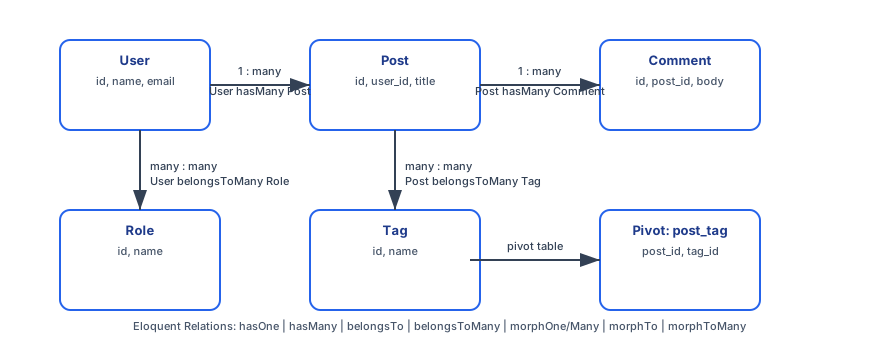
Pivot extras:
php
return $this->belongsToMany(Tag::class)->withTimestamps()->withPivot('added_by');return $this->belongsToMany(Tag::class)->withTimestamps()->withPivot('added_by');Query with constraints:
php
User::whereHas('posts', fn($q) => $q->published())->get();User::whereHas('posts', fn($q) => $q->published())->get();Eager load counts:
php
User::withCount(['posts as published_posts_count' => fn($q) => $q->published()])->get();User::withCount(['posts as published_posts_count' => fn($q) => $q->published()])->get();7. Query Builder vs Eloquent Builder
Raw Query Builder:
php
DB::table('posts')->where('active',1)->orderBy('created_at','desc')->limit(10)->get();DB::table('posts')->where('active',1)->orderBy('created_at','desc')->limit(10)->get();Eloquent (preferred for models):
php
Post::query()->where('active',1)->latest()->take(10)->get();Post::query()->where('active',1)->latest()->take(10)->get();Chunking large sets:
php
Post::where('active',1)->chunk(200, function($posts){
  foreach($posts as $post){ /* process */ }
});Post::where('active',1)->chunk(200, function($posts){
foreach($posts as $post){ /* process */ }
});Streaming via cursor (lower memory):
php
foreach(Post::where('active',1)->cursor() as $post){ /* ... */ }foreach(Post::where('active',1)->cursor() as $post){ /* ... */ }8. Global & Local Scopes
Local scope example already shown (scopePublished). Use: Post::published()->get().
Global scope:
php
class PublishedScope implements Scope
{
  public function apply(Builder $builder, Model $model): void
  {
    $builder->whereNotNull($model->getTable().'.published_at');
  }
}

class Post extends Model
{
  protected static function booted()
  {
    static::addGlobalScope(new PublishedScope);
  }
}
class PublishedScope implements Scope
{
public function apply(Builder $builder, Model $model): void
{
$builder->whereNotNull($model->getTable().'.published_at');
}
}
class Post extends Model
{
protected static function booted()
{
static::addGlobalScope(new PublishedScope);
}
}Remove global scope temporarily: Post::withoutGlobalScope(PublishedScope::class)->get();
9. Attribute Casting
| Cast | Purpose | Example |
|---|---|---|
datetime | Carbon date handling | 'published_at' => 'datetime' |
immutable_datetime | CarbonImmutable | 'deleted_at' => 'immutable_datetime' |
array | JSON to array | 'meta' => 'array' |
encrypted | Auto encrypt/decrypt | 'secret' => 'encrypted' |
asCollection | JSON -> collection | Custom caster |
decimal:2 | Format decimals | 'price' => 'decimal:2' |
Custom cast class (implements CastsAttributes):
php
class MoneyCast implements CastsAttributes
{
  public function get($model, string $key, $value, array $attributes)
  { return $value / 100; }
  public function set($model, string $key, $value, array $attributes)
  { return (int) round($value * 100); }
}
class MoneyCast implements CastsAttributes
{
public function get($model, string $key, $value, array $attributes)
{ return $value / 100; }
public function set($model, string $key, $value, array $attributes)
{ return (int) round($value * 100); }
}Usage: protected $casts = ['price' => MoneyCast::class];
10. Accessors & Mutators (Modern Syntax)
php
protected function title(): Attribute
{ return Attribute::make( get: fn($v) => Str::title($v), set: fn($v) => strtolower($v) ); }
protected function title(): Attribute
{ return Attribute::make( get: fn($v) => Str::title($v), set: fn($v) => strtolower($v) ); }Legacy style (still works):
php
public function getTitleAttribute($value){ return Str::title($value); }
public function setTitleAttribute($value){ $this->attributes['title'] = strtolower($value); }
public function getTitleAttribute($value){ return Str::title($value); }
public function setTitleAttribute($value){ $this->attributes['title'] = strtolower($value); }11. Soft Deletes
Enable in migration ($table->softDeletes();) + model uses SoftDeletes trait. Querying:
php
Post::withTrashed()->find($id);
Post::onlyTrashed()->where('title','like','Draft%')->get();
Post::find($id)->restore();
Post::find($id)->forceDelete();Post::withTrashed()->find($id);
Post::onlyTrashed()->where('title','like','Draft%')->get();
Post::find($id)->restore();
Post::find($id)->forceDelete();12. Transactions (Why They Matter)
Transactions bundle multiple SQL statements into an "all-or-nothing" unit of work. If any step fails, the database reverts to the state before the transaction began. This prevents partial writes (e.g., order created but line items missing, wallet deducted but invoice not recorded) that can corrupt business invariants.
12.1 ACID Principles
| Principle | Meaning | Practical Example |
|---|---|---|
| Atomicity | All statements commit or none do | Order + OrderItems + Payment row all succeed or all rollback |
| Consistency | DB moves from one valid state to another | Constraints (FK, unique) always satisfied |
| Isolation | Concurrent transactions do not interfere incorrectly | Two users updating same balance don't corrupt it |
| Durability | Once committed, data persists even after crashes | Payment record remains after server reboot |
12.2 Laravel Usage Patterns
Basic closure form (auto commit / rollback):
php
DB::transaction(function () use ($request) {
  $order = Order::create($request->validated());
  $order->items()->createMany($this->buildItems($request));
  $order->recalculateTotals();
});DB::transaction(function () use ($request) {
$order = Order::create($request->validated());
$order->items()->createMany($this->buildItems($request));
$order->recalculateTotals();
});Manual form when you need finer granularity:
php
DB::beginTransaction();
try {
  $wallet->debit($amount);
  $transfer = $wallet->transfers()->create([...]);
  DB::commit();
} catch (Throwable $e) {
  DB::rollBack();
  report($e);
  throw $e; // rethrow so caller knows it failed
}DB::beginTransaction();
try {
$wallet->debit($amount);
$transfer = $wallet->transfers()->create([...]);
DB::commit();
} catch (Throwable $e) {
DB::rollBack();
report($e);
throw $e; // rethrow so caller knows it failed
}Nested logic: if you call DB::transaction inside another, Laravel uses savepoints (where supported) so inner failures roll back to the savepoint instead of the outer root.
12.3 Common Use Cases
- Financial operations (credits, debits, wallet top-up).
- Inventory reservation & order creation.
- Multi-table writes (user + profile + roles assignment).
- Event sourcing snapshots + events append.
- Generating sequential numbers with locking.
12.4 Isolation Levels (RDBMS Concept)
Most MySQL installations default to REPEATABLE READ; Postgres often READ COMMITTED. Phenomena to avoid:
| Phenomenon | Description | Mitigation |
|---|---|---|
| Dirty Read | Read uncommitted data | Use READ COMMITTED or higher |
| Non-Repeatable Read | Same row returns different values in one tx | REPEATABLE READ |
| Phantom Read | New rows appear in range scans | SERIALIZABLE or explicit locking |
You can set isolation per transaction (MySQL example):
php
DB::statement('SET TRANSACTION ISOLATION LEVEL READ COMMITTED');
DB::transaction(function(){ /* ... */ });DB::statement('SET TRANSACTION ISOLATION LEVEL READ COMMITTED');
DB::transaction(function(){ /* ... */ });(Keep explicit isolation changes rare; rely on sensible defaults.)
12.5 Locking Rows
When updating counters / balances:
php
DB::transaction(function(){
  $wallet = Wallet::where('id', 5)->lockForUpdate()->first();
  $wallet->balance -= 1000;
  $wallet->save();
});DB::transaction(function(){
$wallet = Wallet::where('id', 5)->lockForUpdate()->first();
$wallet->balance -= 1000;
$wallet->save();
});lockForUpdate() prevents other transactions from modifying the same row until commit (pessimistic lock). Alternatively use optimistic locking (custom version column + compare & retry) for high-read, low-write contention.
12.6 Handling Deadlocks & Retries
Deadlocks can occur with concurrent different update orders. Pattern:
php
function withRetry(int $times, Closure $callback) {
  beginning:
  try { return DB::transaction($callback); }
  catch (Throwable $e) {
    if ($times-- > 0 && str_contains($e->getMessage(), 'Deadlock')) {
      usleep(random_int(10_000, 100_000));
      goto beginning; // simple retry; or loop
    }
    throw $e;
  }
}
function withRetry(int $times, Closure $callback) {
beginning:
try { return DB::transaction($callback); }
catch (Throwable $e) {
if ($times-- > 0 && str_contains($e->getMessage(), 'Deadlock')) {
usleep(random_int(10_000, 100_000));
goto beginning; // simple retry; or loop
}
throw $e;
}
}Use sparingly; better to order updates consistently (e.g., always lock rows by ascending primary key).
12.7 Events After Commit
Model events fire inside the transaction; dispatching jobs that depend on committed data risks race conditions. Use afterCommit() for jobs:
php
DB::transaction(function(){
  $order = Order::create([...]);
  SendOrderEmail::dispatch($order)->afterCommit();
});DB::transaction(function(){
$order = Order::create([...]);
SendOrderEmail::dispatch($order)->afterCommit();
});Or globally in a model event: SendOrderEmail::dispatch($order)->afterCommit();
12.8 Outbox Pattern (Integrations)
To ensure external side-effects (e.g., publish to Kafka) are not lost:
- Inside the transaction, insert into an
outboxtable (status=pending, payload=JSON). - Commit.
- Separate worker polls outbox, sends messages, marks processed.
This guarantees durability even if the app crashes after commit but before calling an API.
12.9 Anti‑Patterns / Pitfalls
| Pitfall | Issue | Better Approach |
|---|---|---|
| Long-running transactions | Holds locks; increases contention | Move slow I/O (HTTP calls) outside transaction |
| Doing external API calls inside transaction | If API hangs, DB locks persist | Persist minimal state, commit, then dispatch job |
Using env() / config changes mid-transaction | Irrelevant but signals mixing concerns | Keep transaction logic pure DB state changes |
| Catching & ignoring exceptions | Silent data corruption | Always rethrow or handle explicitly |
| Large batch writes without batching | Transaction log bloat | Chunk into smaller transactions |
12.10 Quick Decision Guide
| Need | Tool |
|---|---|
| Multiple dependent writes | Wrap in DB::transaction |
| Prevent concurrent modification | lockForUpdate() inside transaction |
| High read / low contention | Optimistic version check (manual) |
| External side effects reliability | Outbox + worker |
| Guarantee post‑commit job | ->afterCommit() on job |
12.11 Summary
Transactions protect invariants. Always ask: "What if step 3 fails after step 2 succeeded?" If the answer is "data inconsistency", wrap it in a transaction.
13. Pagination & Cursor Pagination
Standard:
php
Post::paginate(15);          // length-aware
Post::simplePaginate(50); // simpler, faster for large offsetsPost::paginate(15); // length-aware
Post::simplePaginate(50); // simpler, faster for large offsetsCursor pagination (no large OFFSET cost):
php
Post::orderBy('id')->cursorPaginate(50);Post::orderBy('id')->cursorPaginate(50);14. Performance Tips
| Area | Tip |
|---|---|
| N+1 Queries | Use with() eager loading & debug with Telescope / Laravel Debugbar |
| Large Exports | Use chunk / cursor / queue jobs |
| Index Usage | Add DB indexes for foreign keys & frequently filtered columns |
| Caching | Cache expensive aggregates (Cache::remember()) |
| Select Columns | Limit columns: Post::select('id','title') |
| Batch Inserts | Use insert([...]) for large seed operations |
| Queue Processing | Offload heavy work (emails, reports) |
| Observers | Avoid heavy logic in model events (delegate to jobs) |
15. Putting It Together (Mini Flow)
Request -> Controller -> Post::published()->with('user','tags')->paginate(15)
        -> Transform (Resource / DTO) -> JSON / Blade View
Request -> Controller -> Post::published()->with('user','tags')->paginate(15)
-> Transform (Resource / DTO) -> JSON / Blade ViewResource example:
php
class PostResource extends JsonResource
{
  public function toArray($request)
  {
    return [
      'id' => $this->id,
      'title' => $this->title,
      'excerpt' => $this->excerpt,
      'author' => $this->user->name,
      'tags' => $this->tags->pluck('name'),
      'published_at' => optional($this->published_at)->toIso8601String(),
    ];
  }
}
class PostResource extends JsonResource
{
public function toArray($request)
{
return [
'id' => $this->id,
'title' => $this->title,
'excerpt' => $this->excerpt,
'author' => $this->user->name,
'tags' => $this->tags->pluck('name'),
'published_at' => optional($this->published_at)->toIso8601String(),
];
}
}Use in controller:
php
return PostResource::collection(Post::published()->with('user','tags')->paginate());return PostResource::collection(Post::published()->with('user','tags')->paginate());16. Summary
Eloquent abstracts common CRUD, but performance and correctness rely on good schema design, indexes, efficient querying, and clear separation (resources, services, jobs). Use scopes & casts to keep controllers thin, and always measure before optimizing.